Subscriber Exclusive

For years, thousands of security professionals on the front lines have known this: the tools they’re given to prevent active threats, assaults or medical emergencies are often reactive, cumbersome, or blind in key moments.
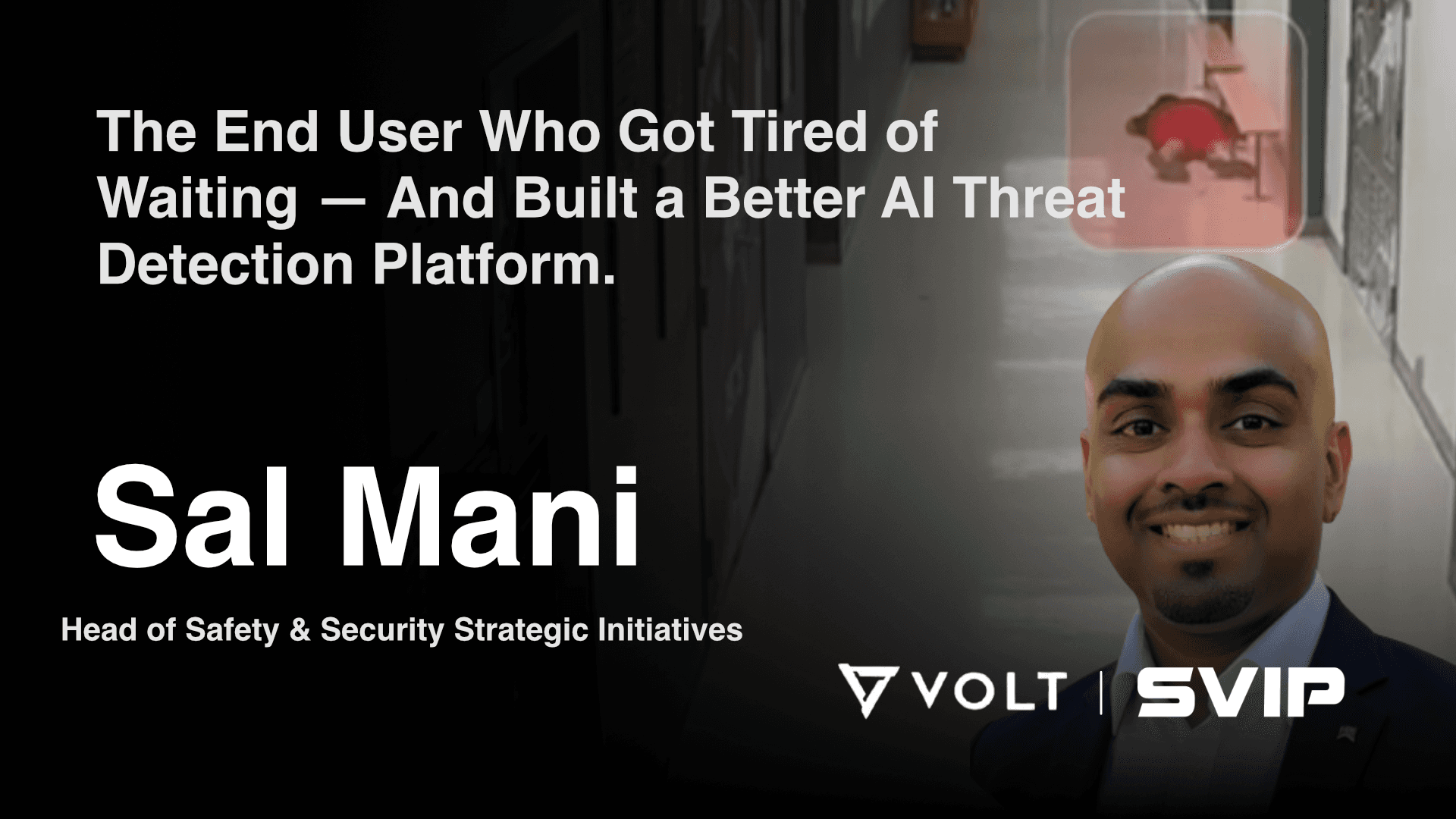
That’s the story of Sal Mani, now Head of Safety & Security Strategic Initiatives at VOLT AI. According to VOLT’s “About Us” page, Mani brings 25+ years of experience in global security, risk-management, Fortune 100 firms, government and higher education environments.
While publicly it isn’t spelled out exactly “I was an end-user, I got tired of what I had to use,” the pieces align: Sal saw that the industry’s innovation around “active threats/assailants” was under-whelming, built for the prior era, not the emerging one.
The genesis of the vision
Mani teamed with co-founders Dmitry Sokolowski (CEO) and Egor Olteanu (COO) — a group whose backgrounds include the U.S. Military, Google X, Apple, Amazon and Meta. Their founding vision: proactive AI protecting people and pushing beyond what’s possible. In short: shift from “watching what happened” to “seeing what’s about to happen” and acting before full-blown crisis.
What sets VOLT AI apart
VOLT AI goes far beyond traditional weapon detection — it delivers real-time threat detection and tracking across a wide range of safety concerns.
Its advanced AI can track individuals even after a weapon goes out of view or is discarded, maintaining continuous situational awareness. The system also detects and alerts security teams to violent behavior, such as aggression or physical altercations, enabling rapid intervention before situations escalate.
Beyond threats, VOLT AI plays a critical role in medical emergency detection. It can recognize when someone collapses due to cardiac arrest or seizures, triggering instant alerts that allow responders to act quickly.
In short, VOLT AI isn’t just about “gun detection.” It delivers comprehensive protection by identifying:
Fights and violent altercations
Medical emergencies (person down, seizure, cardiac arrest)
Restricted access, loitering, abandoned objects, and perimeter breaches
This broader, proactive coverage is why VOLT AI is rapidly gaining adoption not only in schools, but also across enterprise environments, corporate campuses, and city infrastructures.
Rapid evolution / more agile than ‘standard’ solutions
Where many traditional vendors still sell metal detectors, access-control, or single-purpose devices, VOLT is building a software-centric, camera-based, AI-driven platform.
Their guide on “Gun and Weapon Detection Through AI” states:
“Modern AI security platforms extend protection beyond weapon detection alone. They identify medical emergencies, unauthorized access, fighting incidents… creating comprehensive safety coverage.” Volt AI Because they rely on existing camera infrastructure (rather than installing heavy new hardware), the deployment can be faster, less invasive, and more scalable.
The frontline story: Why someone like Sal Mani built this
Imagine being tasked with protecting a school, a corporate campus, a facility. You install cameras, alarms, metal-detectors. You try training, drills, policies. And yet: someone could walk in a side door, drop a weapon, move it off-camera, hide it, then start an assault. Or someone could collapse with a seizure or heart attack and go unnoticed. And you think: “There must be a better way.”
That frustration, that recognition of the gap between reality and “what we have to use,” is what appears to drive the VOLT story. A former “end-user” (or at least someone deeply familiar with the operational side) saying: “I’m done being reactive — let’s build a system that sees the threat, tracks the threat, alerts the threat in progress, and saves lives.”
Why this matters now
The threat landscape has changed: active assailants, mass-violence events, medical emergencies, evolving weapons — traditional security tools are reacting too slowly.
Institutions (K-12 schools, higher ed, corporate campuses, cities) are under pressure: budgets, liability, regulatory oversight, public trust.
A platform that integrates detection of weapons + fighting + medical emergencies offers operational practical benefits (fewer systems to manage, faster alerts, better situational awareness).
Because VOLT’s platform works with existing cameras and adds AI and software, it is more scalable and may offer faster ROI compared to full hardware overhauls.
What the market is saying
On VOLT’s site, one end user testimonial stands out:
“This is the first time where I really have been able to be out ahead of things that are happening. I’m not just using my cameras for investigation, I’m using them for immediate action and response which is pretty special.” — Adam Neely, Principal, Prescott High School Volt AI
That kind of statement is significant: the shift from “footage review after the fact” to “action while it’s happening.” Also, their solution is gaining adoption beyond just schools — including corporate and industrial sectors.
Transparent Pricing
VOLT AI chooses to publicly display their pricing on their website here
K-12 Schools (public and private): $365 per camera per year.
Monthly equivalent: ≈ $30.42 /month per camera ($365 ÷ 12).
Higher Education (colleges and universities): $660 per camera per year.
Monthly equivalent: ≈ $55.00 /month per camera ($660 ÷ 12).
Enterprise (commercial organizations): Pricing is customized — you must contact VOLT AI for a quote. We expect their pricing to be around $60-$75/month per camera.
What This Means
As a school administrator, for each camera you install with VOLT AI at the K-12 rate, you’re looking at roughly $30/month for AI-driven threat detection, tracking, and incident alerts (weapons, fights, medical emergencies, etc).
For higher-ed institutions, the investment grows to about $55/month per camera, reflecting potentially higher volume, more complex environments, or added features.
For enterprises, since the pricing is bespoke, you’ll likely see volume- or feature-based tiers, and you’ll negotiate based on number of cameras, coverage areas, support levels, etc.
Even so, VOLT AI’s pricing is notably more affordable than many others in the industry.
Considerations & what's ahead
Of course, no technology is magic. Some things to keep in mind:
While VOLT describes tracking and detection capabilities, integration with security operations and human response remains critical. The earlier article by Sal Mani on “AI can help schools respond smarter to swatting” emphasizes combining AI + humans + process. Campus Safety Magazine
The competitive landscape includes other vendors, some of which have faced accuracy or transparency concerns.
Deployment planning — camera coverage, rule tuning (object left behind, loitering thresholds, etc) — is still required. The technology gives power, but the operation must be designed.
Side-by-side: VOLT AI vs. ZeroEyes vs. Omnilert
Feature/Focus | VOLT AI | ZeroEyes | Omnilert |
Core approach | Multi-incident video AI with human validation (activity-based, not identity) | Visible gun detection layered on existing cameras + 24/7 human verification (ZOC) | Visual gun detection with automated response workflows |
Detects fights/bullying | Yes | No (gun-focused) | No (gun-focused) |
Medical emergencies (person down/seizure) | Yes | No | No |
Tracking after concealment/disposal | Yes (continuous person tracking) | Not stated | Not stated |
Human verification | Yes (staff validators) | Yes (military/law-enforcement trained analysts) | Vendor-verified workflows; focus is gun alerts |
Typical adopters | K-12, enterprise, campuses, industrial | K-12, higher-ed, public/DoD sites | K-12 districts |
Notable public examples | Loudoun County PS; Prescott HS | Midland Christian School; many districts | Uvalde CISD program/grant |
Uses existing cameras | Yes | Yes | Yes |
SVIP plans to release a comprehensive Verified review of VOLT AI in 2026. For more information regarding their technology, please contact their team here.
Do you have security insights to share? Contact us here!